Changes to OpenAI's Plans and Key Information
OpenAI's new plan policy looks likely to stir up plenty of debate and controversy
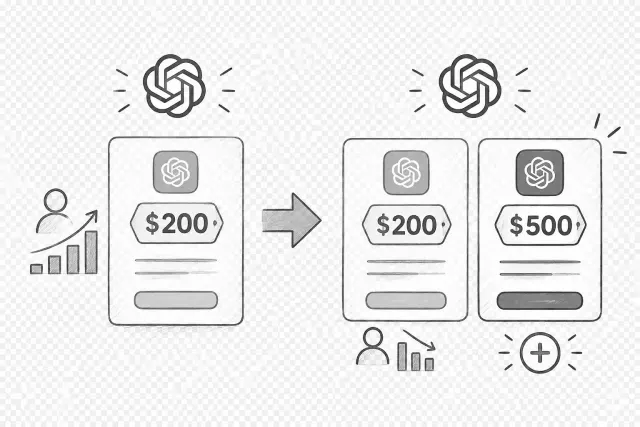
OpenAI has just added a $500/mo plan. Users on the existing $200 plan might feel that their current benefits are shrinking and that they're being nudged toward a more expensive product. Tibo has said the company is moving toward lowering overall model prices while reducing plan usage limits.
OpenAI explains that its models have become more efficient and cheaper, so users can get more done. But existing users first want to know something: will they be able to do the same amount of work they've been doing going forward?
OpenAI's Tibo Sottiaux has been quite direct in his explanation. He says that if you convert the allowance of the new Pro $200 plan into API prices, it's equal to half of the old plan. Here, "half" refers not to the number of messages or tasks, but to the value of usage converted at API prices.
A follow-up explanation also presented the differences between plans in numbers. With Plus as 1x, Pro at $100 is 5x and the new Pro at $200 is 10x. The 20x multiplier attached to the old $200 plan is effectively changing to 10x. For existing subscribers, there will be a transition period: they will keep 20x for a certain time, and OpenAI has said it will also provide extra credits. However, the announcement does not specify in detail how long the grace period lasts, or how many credits will be given and until when they can be used. If you're an existing user, you should check the notice that arrives in your account.
If the models and tasks you mainly use cost the same, a reduction in budget could lead to a reduction in the amount of work you can handle. People who are satisfied with cheaper models and people who must keep using specific high-performance models will inevitably feel the change differently. The efficiency gains from switching models and the benefits of keeping your existing usage terms should be compared separately.
To be fair to existing $200 plan users, they are even being given up to 62,500 credits (worth roughly 3 million KRW).
So how should we interpret the claim that "you can use the $200 plan less than before"? First, you need to distinguish between a case where the base limit itself has been reduced and a case where the same limit is used up faster. Tibo explained that they are raising the baseline allowances across Plus and Pro while adjusting the relative differences between plans. Since the reference point, Plus's allowance, is changing, you cannot calculate the actual reduction rate from the multipliers alone. Even so, the fact stated in the first announcement, that the API-converted value is half of the previous Pro, has not disappeared.
Along with these changes came the $500 monthly Pro plan. The official pricing page lists the $100, $200, and $500 products side by side, and it highlights Astra Ultrafast as the main differentiator of the $500 product. Ultrafast increases Astra's token generation speed by up to 8x compared with Standard mode in Codex and ChatGPT Work. But the usage included in the subscription is deducted at 8x the rate. That doesn't mean every task finishes 8 times faster. It may be appealing to users who value speed, but it's hard to expect that looking at the price alone will increase how much work you can get done by the same proportion.
Moving from $200 to $500 means paying $300 more every month, or a $3,600 difference per year. At this level, the purchase decision should center not on the number of new features, but on the waiting time you actually save at work and the additional amount of work you can finish.
What's disappointing about this overhaul is how much users have to calculate on their own. Subscription fees, relative usage multipliers, model prices, and speed-based deduction rates are all intertwined. An explanation that simply says "you can do more" does little to ease the anxiety of people paying a fixed monthly fee.
Comments 4
- Loading comments.